高樓低廈,人潮起伏,
名爭利逐,千萬家悲歡離合。

閑雲偶過,新月初現,
燈耀海城,天地間留我孤獨。

舊史再提,故書重讀,
冷眼閑眺,關山未變寂寞!

念人老江湖,心碎家國,
百年瞬息,得失滄海一粟!

徐訏《新年偶感》

顯示包含「Itamar Rabinovich」標籤的文章。顯示所有文章

2013年8月14日星期三

Itamar Rabinovich: Defusing the Syrian Time Bomb

TEL AVIV – It is remarkable that a stern warning about the scale of the threat posed to the United States by Syria’s civil war has gone practically unnoticed. Is President Barack Obama’s administration stumbling toward the abyss?
This illustration is by Pedro Molina and comes from <a href="http://www.newsart.com">NewsArt.com</a>, and is the property of the NewsArt organization and of its artist. Reproducing this image is a violation of copyright law.Earlier this month, the Wall Street Journal reported that, according to the CIA’s deputy director, Michael Morell, “Syria’s volatile mix of Al Qaeda extremism and civil war now poses the greatest threat to US national security” – indeed, “probably the most important issue in the world today.” By contrast, Morell described the Iranian regime’s “merging of...nuclear ambitions with its desire to be a hegemonic power in the Middle East” as a mere “cause for concern.” Morell, who is preparing to step down from the CIA soon, has little reason to dissemble.

Just two months ago, in mid-June, when the Syrian crisis was the focus of international attention and the subject of heated policy debate, such a statement by a senior administration official would have drawn strong reactions from several quarters. But Syria has since moved from the center of attention, displaced by the coup and ongoing crisis in Egypt, the threat of an Al Qaeda terror offensive in Yemen and elsewhere, and the renewal of Israeli-Palestinian negotiations.

The apparent (and deceptive) lull in the fighting in Syria has contributed to this shift. After the government’s military achievements in Quseir and Homs, there has been some tactical regrouping by the opposition. Both sides are trading minor blows as they prepare for a major round of fighting in Aleppo, Syria’s largest city, now held by the opposition. Overall, and despite the regime’s recent victories, the fighting remains at a stalemate.

So this is a convenient time for the international community to look away from a crisis that seems to have no good solutions. But this does not diminish the gravity of what is happening in Syria, or lessen the seriousness of Morell’s warning.

As Morell put it, the most acute danger is that a regime with a large stockpile of weapons of mass destruction will be supplanted by a regime affiliated with, or dominated by, Al Qaeda. Pointing to the inflow of jihadis, Morell said that Syria’s “current track is toward the collapse of its central government,” after which it would replace Pakistan as Al Qaeda’s preferred haven.

Morrell thus placed himself squarely within one of the two principal schools of thought in the policy debate on Syria (a debate that is articulated almost exclusively in geopolitical terms and ignores humanitarian issues).

One school regards Syria primarily as a theater of battle against Al Qaeda and other extremists. Its adherents, preoccupied with the prospect of a jihadi takeover in Syria, argue (sometimes implicitly and sometimes explicitly) that the US and its allies must not support or intervene on the side of the rebels and, in fact, should view Bashar al-Assad’s regime as the lesser evil.

Those who fear a jihadi takeover cite recent events in Sinai. Just a few days ago, Israel closed its airport in Eilat after receiving a warning that jihadis in Sinai planned to attack it with rockets. This, it is argued, is only a dress rehearsal for what can be expected in a post-Assad Syria.

The other school of thought does not take this scenario lightly. Nonetheless, it argues that a victory in Syria by a coalition of Russia, Iran, Hezbollah, and Assad’s regime would pose an even greater danger. Moreover, in the event of the Assad regime’s fall, there would be plenty of ways to deal with the jihadi groups in Syria.

But the most appropriate response to Morell’s statement is that the US does not necessarily have to choose between two sharply defined options. Yes, Syria’s secular opposition is weak and divided, while the jihadis are more dynamic; but jihadi supremacy in the event of an opposition victory is not inevitable. The US and its allies should conduct a robust policy, make a more significant investment in the secular opposition, and articulate clear goals.

In June, Obama announced that Assad’s regime had used chemical weapons against its own population and had thus crossed his administration’s “red line.” But no coherent action or policy followed this powerful statement. For Obama, Syria’s fate simply does not seem urgent; but when the decisive battle for Aleppo begins, it may be too late. Morell’s warnings may yet be vindicated – by default, if not by design.


Itamar Rabinovich, a former ambassador of Israel to the United States (1993-1996), is currently based at Tel Aviv University, New York University, and the Brookings Institution.

2012年2月16日星期四

Itamar Rabinovich: The Iranian Nuclear Threat Goes Global


TEL AVIV – The current drive to prevent Iran from developing a nuclear arsenal reflects two important, and interrelated, changes. From Israel’s perspective, these changes are to be welcomed, though its government must remain cautious about the country’s own role.
The first change is the escalation of efforts by the United States and its Western allies to abort the Iranian regime’s nuclear quest. This was instigated in part by the International Atomic Energy Agency’s finding in November 2011 that Iran is indeed developing a nuclear weapon, and that it is getting perilously close to crossing the “red line” – the point beyond which its progress could no longer be stopped. Moreover, the US and its allies understand that failure to take serious action might prompt Israel to launch its own unilateral military offensive.

The second change is the perception that Iran’s nuclear capacity would threaten not only Israel. In a speech to the Union for Reform Judaism in December, US President Barack Obama stated that “another threat to the security of Israel, the US, and the world is Iran’s nuclear program.” But, by this February, Obama was saying of Iran that “my number-one priority continues to be the security of the US, but also the security of Israel, and we continue to work in lockstep as we proceed to try to solve this…”

That choice of words was no accident; rather, it was a sign that the US is changing tack when it comes to Iran. For more than a decade, the question “Whose issue is it?” has been part of the policy debate about Iran’s nuclear ambitions. Israel’s former prime minister, Ariel Sharon, used to caution his colleagues against “rushing to the head of the line” on Iran. He argued that if Israel were to take the lead in sounding the alarm on Iran’s nuclear ambitions, the issue would be perceived as yet another “Israeli problem.”

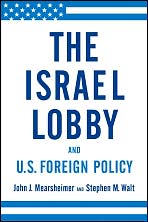
Indeed, Israel’s critics were already arguing that this was another case of the tail wagging the dog – that Israel and its American lobby were trying to push the US into serving Israel’s interests rather than its own. The most egregious examples of this view were statements made by the political scientists John Mearsheimer and Stephen Walt. In a paper published prior to the release of their much-debated book The Israel Lobby, they argued:

“… Iran’s nuclear ambitions do not pose an existential threat to the US. If Washington could live with a nuclear Soviet Union, a nuclear China, and even a nuclear North Korea, then it can live with a nuclear Iran. And that is why the [Israel] Lobby must keep constant pressure on US politicians to confront Tehran.”

Israel’s current prime minister, Benjamin Netanyahu, has been less worried than Sharon was about Israel’s perceived role. He is too busy being directly engaged in the attempt to eliminate the deadly threat that a nuclear-armed Iran would pose to the Jewish state.

Prior to the 2009 election that brought him to power, Netanyahu campaigned on the Iranian danger, and his government made the issue its cardinal concern. Together with his defense minister, Ehud Barak, Netanyahu succeeded in persuading Obama and the rest of the world that Israel was preparing a military attack as a last resort, should the US and its allies fail to stop the Iranian program in time.

That policy has been effective, but it has also drawn attention to Israel’s influence on the Iran question. Curiously, this has not been held against Israel, at least not so far, partly because Obama and other leaders now regard Iran as a more serious threat, and therefore feel the need to take appropriate action.

The international community must underscore that its members are acting in the service of their national interests, and not simply for Israel’s sake. But their willingness to engage could wane, particularly if sanctions exact a high financial price or military action causes a large number of casualties.

Israel would therefore be wise to remember Sharon’s cautionary words, and reinforce its pressure on the US administration with a broader diplomatic campaign. Like it or not, Israel must urge the world to remember that Iran is everyone’s problem.

Itamar Rabinovich, a former ambassador of Israel to the United States (1993-1996), is currently based at Tel Aviv University, New York University, and the Brookings Institution.