高樓低廈,人潮起伏,
名爭利逐,千萬家悲歡離合。

閑雲偶過,新月初現,
燈耀海城,天地間留我孤獨。

舊史再提,故書重讀,
冷眼閑眺,關山未變寂寞!

念人老江湖,心碎家國,
百年瞬息,得失滄海一粟!

徐訏《新年偶感》

顯示包含「Gulf Stream Blues」標籤的文章。顯示所有文章

2012年5月1日星期二

Gulf Stream Blues: The battle for the May Day voter


The first of May is always a big deal in France. This year it’s taken on an even more politically charged tone, with groups of far-left and far-right demonstrators possibly coming into conflict during the course of today. But it might be hard today to differentiate between the two groups based on their rhetoric alone.

May Day, originally a pagan spring festival, became an international workers day in the late 19th century. Ironically this Socialist holiday is unknown in the United States, despite the fact that it actually commemorates the 1886 Haymarket Massacre in Chicago. An American ‘Labor Day’ was instead set in September so that it wouldn’t coincide with international workers demonstrations. The day has long since lost any association with workers rights in the US.

But in continental Europe, the 1st of May is still a public workers holiday during which labour unions and activists demonstrate in the streets. It is also known for anti-capitalist violence, particularly in Southern Europe.

In recent years, the increasingly mainstream far right in Europe has challenged the idea that May Day is the sole domain of the left. The National Front party in France has begun to stage May day marches to the Place de l’Opera in Paris. There they hold a rally in front of a statue of Joan of Arc, who they have adopted as a symbol. This year, following the record 18% showing of National Front leader Marine Le Pen in last Sunday’s first round of presidential elections, it is predicted that they will garner the largest turnout ever.

This could possibly put them into conflict with the traditional labour union marches that take place on May Day, as well as the rallies of far left leaders such as presidential candidate Jean-Luc Melenchon, who polled at 11% in the first round.

Similar rhetoric 

But whether it’s a rally of the Left Party or the National Front, much of the language being used sounds awfully similar. Both of them blame ‘Brussels’ for France’s problems and say the European project is a conspiracy to exploit the French worker.


Le Pen has been keen to present herself as a champion of the common man and a defender of workers rights. She rails against the “aristocrats” in Paris and the “elites” in Brussels, and says both President Sarkozy and his Socialist challenger Francois Hollande represent the interests of the rich and powerful. Globalisation and Europeanisation, she tells the French, is to blame for the problems they face.

Her language, which seems to borrow a large rhetorical template from the far left, is part of an effort to rebrand the party from the toxic reputation it accrued under her father Jean-Marie Le Pen. Gone is the openly racist language of her father. Le Pen the younger now disavows racism and says she only wants to protect the ethnic French from the incursion of Muslim immigrants and pan-Europeanisation. "You want to feel at home in your own country," has become her main rallying cry. It is part of a larger trend of far-right parties in Europe rebranding themselves to make them more palatable to more people.

Meanwhile the hard left Melenchon, who presents himself as the inheritor of the French revolutionary tradition, uses much of the same kind of language in his rallies. He also blames globalisation and the EU push for laissez-faire economics and austerity for causing harm to the ordinary French worker.

It’s no wonder then that a significant portion (some estimates say half) of the people who voted for the National Front in the first round will vote for the centre-left Socialist Party in the second round. That a far right supporter would within two weeks switch his allegiance to the centre-left might seem perplexing. But in truth so much of the National Front vote was an anti-establishment vote intended as a rebuke to Sarkozy for not doing enough to ‘protecting the French way of life’.

Hollande is unlikely to satisfy their desires in this area either. But it would seem that the devil they don’t know is better than the one that they do. Hollande, who actually has little experience in elected governing positions, is a blank template onto which they can project their wishes and desires – no matter how vague and ethereal those desires are.

Sarko’s last stand 

But of course the key difference is that Melenchon is backing the mainstream centre-left candidate Francois Hollande, while Le Pen is refusing to back the centre-right Sarkozy. It is because of this fact that Sarkozy will almost certainly lose in the final round of voting this weekend. Even though he has adopted much of the language of the far right, they feel betrayed by him because he hasn’t reversed the tide of immigration or changed France into an all-white Christian stronghold overnight.
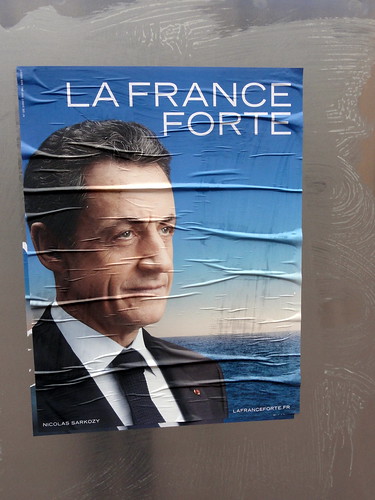
Of course much of what they are demanding is impossible. So any incumbent would be unlikely to have satisfied their demands. But that hasn’t stopped Sarko from trying in these desperate last days. He is planning a rally at the Trocadero today, which has infuriated labour unions who say it will interfere with their workers’ marches. It didn’t help sooth their anger when, according to the BBC, he said his rally will showcase “real work”.

No doubt at today’s rally it will be hard to ifferentiate Sarko’s language from that of Le Pen or Melenchon. In recent days he’s attacked the EU for "weakening the concept of the nation". He has promised that he will not “let France be diluted by globalisation” and asserted that “Europe has given in too much to free trade and deregulation". His recent speeches have also been almost maniacally obsessed with the French border.

Meanwhile Hollande has stuck with his greatest asset in this campaign – his perceived stability and level-headedness. He has not changed his rhetoric to court either the far right or the far left. But in this age of increasing populism, can Mr Hollande stay immune from the shrieking all around him for much longer?

The unsettling success of the National Front in the French election has been unsettling for governments across Europe. How will they react to it? Will they adopt their rhetoric as Sarkozy has chosen to do, or will they shift tack and devise a new solution to the crisis that can restore people’s faith in government?

All eyes will be on Hollande after this Sunday, should he win, to see whether he intends to lead a new ‘Socialist way’ out of the crisis as an alternative to Angela Merkel’s austerity push. With the recent collapse of centre-right governments in the Czech Republic, the Netherlands and Romania, he may soon have more Socialist governments to join his cause. But will this be enough to stem the rise of Europe’s far right?

2012年1月26日星期四

Gulf Stream Blues: Europe’s SOPA?


The European Parliament’s website has been shut down by hackers today, allegedly in a denial-of-service attack from Anonymous in protest of imminent anti-piracy legislation restricting internet freedom. But as the IT folks in parliament scramble to fix the problem, the functionaries are sitting around scratching their heads in confusion. Did we pass internet piracy legislation?

Their confusion is warranted. By all accounts the EU has been on the internet-freedom-lovers side during this debate. During the fallout from the Wikipedia ‘blackout’ last week, US politicians weren’t the only ones beating a path to the door to distance themselves from the now toxic SOPA legislation on internet piracy. On Friday the EU’s Digital Agenda Commissioner Neelie Kroes tweeted that she was “glad the tide is turning on #SOPA,” adding “speeding is illegal too: but you don't put speed bumps on the motorway”.

Home Affairs Commissioner Cecilia Malmström also tweeted against the US legislation, noting that ‘sopa’ in Swedish means garbage. Notably, no public statements about the US anti-piracy bills had been made before the blackout. It’s quite unusual for the EU to make comments about US legislation. But such was the effect of the Wikipedia blackout – which was, after all, global, that even politicians not involved in US lawmaking felt the need to make a statement about it.

Kroes was eager to point out during the global protest that there is no EU version of SOPA being considered. And she is right. But there is an international treaty which internet freedom advocates say is just as bad as SOPA, and it is heading toward a speedy passage in the EU. It is called ACTA, or the Anti-Counterfeiting Trade Agreement.

ACTA was originally forged between the United States and Japan, and other countries can join voluntarily. It seeks to create an international body outside the WTO or the World Intellectual Property Associaiton (WIPO) establishing a legal framework for copyright violations, including those that occur on the internet. So far it has been signed by the US, Japan, Australia, Canada, Morocco, New Zealand, Singapore and South Korea.

Today the European Commission and all 27 member states signed the treaty. But in order for the EU to become a party to it, the European Parliament must now endorse it. Hence the denial-of-service attack on the Parliament today. Some are saying it’s a bit strange for anonymous to be going after the Parliament when it was the Commission and the Council who signed the treaty today, and perhaps it reflects a lack of knowledge from the hackers on how the EU works. It is unclear at this stage whether the hackers were confused and thought the EU parliament had just signed the treaty, or if they intend this as a warning to MEPs to vote against this treaty in June.

The European Parliament doesn’t get to play a pivotal role in European lawmaking all that often, so the fact that a decision over whether the world’s largest common market will sign up to this treaty is now up to them will likely be sending MEPs’ heads spinning with sudden feelings of consequentiality.

But MEPs cannot be swayed only be, as some have termed them, “internet thugs”. They need to find out, is ACTA really as bad as the internet freedom advocates are saying? I’m no expert, so here’s a summary of the criticism of the treaty. From what I can gather the MEPs don’t seem to have paid a lot of attention to this until now. But they did pass a resolution in 2010 during the early stages of ACTA negotiations saying that it must respect freedom of expression and right to privacy. So they’ve already signalled they will be a sceptical audience.

The Commission has apparently been desperate to avoid ACTA getting the SOPA treatment. Today’s attack will certainly alarm them – but I doubt it’s going to get enough media attention to get them really scared. It would take another Wikipedia blackout to really frighten them.

The Commission has been keen to portray itself as a protector of online privacy and internet freedom, as opposed to the US government. Just yesterday they proposed an overhaul of data protection rules that will force internet companies to allow users to opt out of data collection. It comes the same week that Google announced it will now force users to accept having their details stored across its sites.

Last week the Commission even released a Q&A about why ACTA is not SOPA. But if the heat gets too intense, they may back off of their support (for instance by not fighting a European Parliament rejection of the treaty). This Commission is keen to be seen as a champion of internet freedom, after all.

2012年1月5日星期四

Gulf Stream Blues: Is Iowa the problem, or is it the primary system?


While I was home in the US over the past few weeks I witnessed the quadrennial spectacle of the Iowa caucuses - shivering reporters in front of the capital dome in Des Moines, candidates eating corn on the cob while clutching plump cord-fed babies, the usual fare. And I was also able to witness the quadrennial griping about why the United States allows “a few hundred farmers” to pick its president.

The complaining about the Iowa caucus, where the first nominating primary for both political parties’ presidential candidates is held, is both predictable and legitimate – even if the language used sometimes smacks of regional snobbery. The Iowa caucus makes or breaks politicians running for the presidency. Barack Obama owes his presidency to winning the Iowa Democratic caucus in 2008. This year, the result of the Republican caucus will force Michele Bachman and Rick Perry to drop out of the race. And the Iowans have elevated Rick Santorum from obscurity to be the main challenger to frontrunner Mitt Romney.

But the Iowa caucus is a big deal only because it is first. And being first means presidential candidates promise Iowa all sorts of lovely things (just look at the corn subsidies of the past four decades – and you wonder why Americans have corn syrup in most of their food for no reason?). The Iowans go through outrageous lengths to make sure they are first. When South Carolina and New Hampshire tried to move their primaries ahead of them this year, Iowa moved theirs to the earliest possible day in 2012 – 3 January.

This year the criticism went perhaps a little too far. A professor at the University of Iowa (himself a transplant from New Jersey) wrote a column for The Atlantic about a much-asked question – why should a state that is not ethnically or ideologically reflective of the country as a whole be given such a prominent role in selecting the nation’s president? But he asked it in a way that was incendiary to say the least, calling Iowa a place that's "culturally backward" and teeming with "slum towns”, where the 96% white population “clings to guns and religion.”

The article spawned a firestorm of criticism from Iowans, the best of which was this video posted on YouTube. ‘He’s an elitist East Coast liberal snob!’ the Iowans cried. But whether or not his observations were accurate (he has lived in Iowa for 20 years and has written two books about the state), the larger point seemed to be lost amidst all the name-calling. Does this system, in which a small group of people in early primary states choose presidential nominees through government-organised elections, really make sense?

An American peculiarity

What is rarely brought up in these discussions about Iowa is that choosing party nominees by public vote is neither a long-standing American tradition nor a common worldwide practice. In fact America is virtually the only nation to choose its leaders based on an extensive system of popular vote primaries. US states only gradually began doing so starting in the early part of the 20th century as a response to the Progressive movement. Before then party nominees were selected by parties themselves – which is the way they are still selected in the vast majority of the world’s democracies.

Nominees used to be selected by party members on the floor of the Democratic and Republican national conventions. Now the open primaries have made the conventions mere political theater, with the nominee actually having been selected long before they are held.

Here in Europe, there is no country that systematically chooses party nominees by popular vote, though a few parties in Europe have experimented with it. Nominees are instead selected by party members or officials (the equivalent of the Democratic and Republican National Committees choosing their chairman). The main reason for this is that most countries in Europe are parliamentary democracies, and the head of government position is awarded to the leader of whichever party wins the greatest number of seats in parliament.

It would therefore be a bit awkward to poll the general public, because party leadership contests don’t usually happen at the same time as the general elections that determine a country’s leader. And sometimes, a party leadership contest can replace a sitting prime minister without a public vote – as occurred in 2007 when Gordon Brown replaced Tony Blair as prime minister of the UK.

Of course that awkwardness hasn’t stopped some of Europe’s Socialist parties from trying the concept a few times, but it has never worked. In 2005 the centre-left Olive Tree coalition organised an open primary to elect a candidate to challenge Silvio Berlusconi in the April 2006 election. That public vote chose Romani Prodi, who then went on to defeat Berlusconi. But the open primary was largely considered a messy failure, because it didn’t reflect the political realities of the Italian parliament. Prodi was toppled from power two years later after he lost the support of the Communists.

It isn’t just the differing parliamentary system which has kept most Democracies from adopting US-style primaries. Even most presidential democracies with the same system as the US don’t hold regular open primaries to determine candidates. In fact the only presidential systems to do so are Chile, Uruguay and Taiwan.

In France, which is the only EU country to have a presidential system like the US, the practice was used for the first time in October of last year by the Socialists (the main centre-left party) to select their nominee. The party organised the polling itself, and anyone who was registered as a Socialist could vote by paying €1 to cover the costs. About three million people participated and they selected François Hollande, the former partner of their 2007 nominee Segolene Royal, as their candidate.

But the public vote was widely criticised for not being compatible with the French political system and for turning French politics into an American-style piece of theatre. Many argued that France’s two-round system of voting make primaries redundant. The country has many political parties that each field a candidate in a 1st round, which whittles the field down to two candidates for the final round. Given that the political spectrum is still dominated by the two main parties (the Socialists and the UMP) it is debatable how much this first round really represents a ‘primary’ as we think of them in America.

Do primaries produce the best candidates?

Of course, just because the rest of the world doesn’t do it doesn’t mean that open primaries are a bad system. And if you believe in American exceptionalism, then the very fact that the US is alone in this practice means it is a good thing to do!

But before ganging up on the Iowans perhaps people should ask themselves if having public primaries at all makes sense. It’s not the Iowans fault that they happen to be the state which is the most skilled and aggressive at putting themselves first in this process. After all, if it wasn’t Iowa then it would be another state going first and determining the shape of the race. And while there are certainly other states that are more reflective of America as a whole, is there really any one state that could legitimately claim to represent the whole nation?

One could argue that maybe every state should hold their primaries on the same day. Such a change would certainly turn the whole primary system on its head, given that it’s geared around a building momentum and a slow testing of how a candidate performs before you cast your vote. But what if candidates were chosen instead only by members of the Republican/Democratic National Committees?

Such a change would likely not be very popular – once you give people the power to vote over something it’s nearly impossible to take it back. But if party officials were choosing candidates, does anyone really believe we’d be seeing candidates like Michelle Bachman or Herman Cain? Would a candidate like Mitt Romney have to be running around the country disavowing virtually every position he’s ever taken in his previous political career as Massachusetts governor in order to be electable by deeply conservative Republican primary voters? Party officials could choose someone who is appealing to the entire electorate, not just to a narrow base. And they could choose the most competent person who would make the best leader rather than just a person who can win votes (ideally at least).

Let’s face it, watching this Republican primary process has been like watching sausage being made. And I’m not sure you’d want to eat the sausage that came out of the process even if you hasn’t seen it created. It’s been an absolute farce, from the 13 debates (and 10 more to go!) which managed to discuss almost nothing of substance despite the over 100 hours of talking, to the circus-like sideshow of Cain’s sexual misconduct. Who actually thinks this is working well?

The primary system’s most ardent defenders, such as New York Times columnist David Brookes, say they still produce the best candidate because they show who can stand up to the rigours of a campaign and who can connect the best with the public. But given that any candidate chosen by the party itself would surely have already held office and would therefore have gone through a campaign, wouldn’t that information already be evident?

Let’s not forget that these primaries are organised at great expense to the taxpayer, since they are (in most cases) organised by the states rather than by the party. Perhaps the most painful part about watching this Republican primary process is knowing that I’m paying for it. Well, not any more, but if I was a US taxpayer I would be. And don’t forget, primaries aren’t just held for the presidency. They’re held for almost every political office. That’s a lot of money.

Inane distractions

The public primaries also have the effect of drawing out the presidential campaign to two years in length, meaning a first-term president spends half of his term campaigning for reelection. These primaries eat up so much air time and so much political focus that they distract from other more important things. In Europe campaigns usually last one month, because elections aren’t called until one month in advance. In the US, the news networks started reporting ad nauseum about the 2012 election at the beginning of 2011.

As we sit at the precipice of the greatest global financial disaster the world has seen since the Great Depression, the US media has spent the past year talking about Herman Cain’s groping, Michele Bachmann’s pray-the-gay-away therapy and Rick Perry’s inability to make a list of more than two things. If the US let the parties go back to selecting their nominees themselves at their conventions, we wouldn’t start the election process until the Spring of the election year, which seems wholly appropriate.

In France, where the 2012 election will be in April, intensive media coverage began earlier than usual this year because of the Socialist’s first nominating public vote in October. It was another complaint made by the French about the country’s first open primary – it took up too much media attention too far in advance of the actual contest. But if France is going to adopt a US-style presidential open primary system, they can expect longer and longer campaigns in the future, with plenty of accompanying debates and distractions. Le Herman Cain anyone?

I don’t think the French want that. And, really, I don’t think the Americans want that either. But at the same time, it’s hard to see the US changing the system. Change doesn’t come easily to the world’s oldest government.