高樓低廈,人潮起伏,
名爭利逐,千萬家悲歡離合。

閑雲偶過,新月初現,
燈耀海城,天地間留我孤獨。

舊史再提,故書重讀,
冷眼閑眺,關山未變寂寞!

念人老江湖,心碎家國,
百年瞬息,得失滄海一粟!

徐訏《新年偶感》

顯示包含「Kemal Derviş」標籤的文章。顯示所有文章

2013年1月17日星期四

Kemal Derviş: The Centrists Cannot Hold


WASHINGTON – In most advanced democracies, a large center-right party competes with a large center-left party. Of course, the extent to which an electoral system favors large parties – by having high popular-vote thresholds to enter parliament, or through winner-take-all constituencies – affects the degree of political fragmentation. But, by and large, the developed democracies are characterized by competition between large parties on the center left and center right. What, then, are true centrists like Mario Monti, Italy’s respected technocratic prime minister, to do?
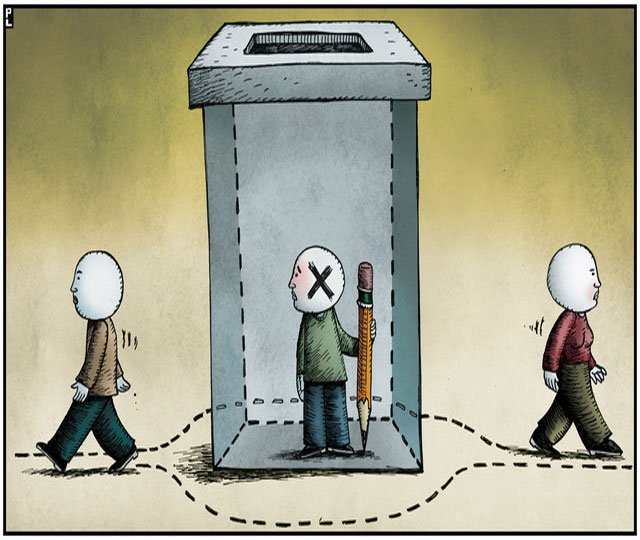
To be sure, regional and ethnic allegiances play a greater role in some places in Europe – for example, Scotland, Belgium, and Catalonia – but far more so in emerging countries, where political cleavages also reflect specific post-colonial circumstances and often the legacy of single-party rule. Nonetheless, even in “emerging market” democracies, such as Chile, Mexico, South Korea, and India, a left-right cleavage plays an important role – while those who claim the political center generally remain weak.

The British Liberal Democrats, for example, have tried for decades to become a strong centrist third party, without success. While the political vocabulary in the United States is different, the Democratic Party, since Franklin Roosevelt’s presidency, is indeed a center-left force, the Republican Party occupies the right, and no other significant party exists.
In France and Germany, there is more fragmentation. Politics is still dominated by a large center-left party and a large center-right party, but smaller groups – some claiming the center and others the right and left extremes – challenge them to various degrees. In some countries, the “Greens” have their own identity, close to the left; but, despite remarkable progress in Germany, they remain unable to reach the electoral size of the large center-right and center-left parties.

Variations of this basic structure exist in Spain, Portugal, Greece, Turkey, and the Nordic countries. The situation is particularly interesting in Italy, where Monti, having decided to contest the upcoming general election, has had to position himself on the right (which he signaled by attending a gathering of the leaders of Europe’s center-right parties). He and former Prime Minister Silvio Berlusconi are now fighting for space on the right, with the center-left Democrats leading in the polls.

There are at least four differences between center-right and center-left approaches to social and economic challenges. The right has greater confidence in markets to allocate resources and provide appropriate incentives; favors private consumption over public goods; is minimally concerned with economic inequality; and tends to be more nationalistic and less optimistic about international cooperation.

The left, by contrast, believes that markets, particularly financial markets, need considerable government regulation and supervision to function well; gives greater weight to public goods (for example, parks, a clean environment, and mass-transit systems); seeks to reduce economic inequality, believing that it undermines democracy and the sense of fairness that is important to well-being; and is more willing to pursue international cooperation as a means to secure peace and provide global public goods, such as climate protection.

When looking at actual economic policies as they have evolved over decades, we see that they always combine center-right and center-left elements. Repeated financial crises have tempered even the right’s faith in unregulated markets, while the left has become more realistic and cautious about state planning and bureaucratic processes. Likewise, the choice between privately consumed and publicly consumed “goods” is often blurred, as politicians tend to reinforce citizens’ understandable tendency to demand public goods while rejecting the taxes needed to pay for them.

As income inequality has increased – dramatically in some countries, such as the US – it is moving to the forefront of the debate, reinforcing the traditional political divide. Nonetheless, the center right and the center left are arguing about the degree of redistribution, not about the need for some progressivity in taxes and transfers. Both also agree on the need for international cooperation in an increasingly interdependent world, with differences mainly concerning how much effort to spend on it.

So, given that differences in policies as they are implemented have become largely a matter of degree, why do centrist parties remain weak? Why have they failed to unite moderates on both sides of the ideological divide?

One reason is that only a minority of any population is active politically. Active party members hold more ideologically consistent views – and hold them more strongly – than most of those who are politically less engaged, giving activists disproportionate influence in the political process. After all, more nuanced ideas and policy proposals are relatively difficult to propagate effectively enough to generate broad and enthusiastic popular support.

But there also really are fundamental differences in values and economic philosophies, as well as in economic interests, leading to a fairly consistent positioning of voters on the right or left. Disagreement may lead to compromises, but that does not change the underlying differences in starting positions.

It is probably a good thing that structured competition between large center-right and center-left parties persists. Such parties can help to integrate the extremes into the political mainstream, while facilitating alternation in power, which is essential to any democracy’s dynamism; a system in which a large centrist party remained permanently in power would be far less desirable. Those, like Monti, who want to mount a challenge from the center, however personally impressive they may be, have steep obstacles to overcome, and for good reasons.


Kemal Derviş, a former minister of economy in Turkey, administrator of the United Nations Development Program (UNDP), and vice president of the World Bank, is currently Vice President of the Brookings Institution.

2012年3月8日星期四

Kemal Derviş: The Inequality Trap


WASHINGTON, DC – As evidence mounts that income inequality is increasing in many parts of the world, the problem has received growing attention from academics and policymakers. In the United States, for example, the income share of the top 1% of the population has more than doubled since the late 1970’s, from about 8% of annual GDP to more than 20% recently, a level not reached since the 1920’s.

While there are ethical and social reasons to worry about inequality, they do not have much to do with macroeconomic policy per se. But such a link was seen in the early part of the twentieth century: capitalism, some argued, tends to generate chronic weakness in effective demand due to growing concentration of income, leading to a “savings glut,” because the very rich save a lot. This would spur “trade wars” as countries tried to find more demand abroad.

From the late 1930’s onward, however, this argument faded as the market economies of the West grew rapidly in the post-World War II period and income distributions became more equal. While there was a business cycle, no perceptible tendency toward chronic demand weakness appeared. Short-term interest rates, most macroeconomists would say, could always be set low enough to generate reasonable rates of employment and demand.

Now, however, with inequality on the rise once more, arguments linking income concentration to macroeconomic problems have returned. The University of Chicago’s Raghuram Rajan, a former chief economist at the International Monetary Fund, tells a plausible story in his recent award-winning book Fault Lines about the connection between income inequality and the financial crisis of 2008.

Rajan argues that huge income concentration at the top in the US led to policies aimed at encouraging unsustainable borrowing by lower- and middle-income groups, through subsidies and loan guarantees in the housing sector and loose monetary policy. There was also an explosion of credit-card debt. These groups protected the growth in consumption to which they had become accustomed by going more deeply into debt. Indirectly, the very rich, some of them outside the US, lent to the other income groups, with the financial sector intermediating in aggressive ways. This unsustainable process came to a crashing halt in 2008.

Joseph Stiglitz in his book Freefall, and Robert Reich in his Aftershock, have told similar stories, while the economists Michael Kumhof and Romain Ranciere have devised a formal mathematical version of the possible link between income concentration and financial crisis. While the underlying models differ, the Keynesian versions emphasize that if the super-rich save a lot, ever-increasing income concentration can be expected to lead to a chronic excess of planned savings over investment.

Macroeconomic policy can try to compensate through deficit spending and very low interest rates. Or an undervalued exchange rate can help to export the lack of domestic demand. But if the share of the highest income groups keeps rising, the problem will remain chronic. And, at some point, when public debt has become too large to allow continued deficit spending, or when interest rates are close to their zero lower bound, the system runs out of solutions.

This story has a counterintuitive dimension. Is it not the case that the problem in the US has been too little savings, rather than too much? Doesn’t the country’s persistent current-account deficit reflect excessive consumption, rather than weak effective demand?

The recent work by Rajan, Stiglitz, Kumhof and Ranciere, and others explains the apparent paradox: those at the very top financed the demand of everyone else, which enabled both high employment levels and large current-account deficits. When the crash came in 2008, massive fiscal and monetary expansion prevented US consumption from collapsing. But did it cure the underlying problem?

Although the dynamics leading to increased income concentration have not changed, it is no longer easy to borrow, and in that sense another boom-and-bust cycle is unlikely. But that raises another difficulty. When asked why they do not invest more, most firms cite insufficient demand. But how can domestic demand be strong if income continues to flow to the top?
Consumption demand for luxury goods is unlikely to solve the problem. Moreover, interest rates cannot become negative in nominal terms, and rising public debt may increasingly disable fiscal policy.

So, if the dynamics fueling income concentration cannot be reversed, the super-rich save a large fraction of their income, luxury goods cannot fuel sufficient demand, lower-income groups can no longer borrow, fiscal and monetary policies have reached their limits, and unemployment cannot be exported, an economy may become stuck.

The early 2012 upturn in US economic activity still owes a lot to extraordinarily expansionary monetary policy and unsustainable fiscal deficits. If income concentration could be reduced as the budget deficit was reduced, demand could be financed by sustainable, broad-based private incomes. Public debt could be reduced without fear of recession, because private demand would be stronger. Investment would increase as demand prospects improved.

This line of reasoning is particularly relevant to the US, given the extent of income concentration and the fiscal challenges that lie ahead. But the broad trend toward larger income shares at the top is global, and the difficulties that it may create for macroeconomic policy should no longer be ignored.


Kemal Derviş, a former minister of economics in Turkey, administrator of the United Nations Development Program, and vice president of the World Bank, is currently Vice President and Director of the Global Economy and Development Program at the Brookings Institution.

2012年1月10日星期二

Kemal Derviş:Global Imbalances and Domestic Inequality


WASHINGTON, DC – Despite years of official talk about addressing global current-account imbalances, they remained one of the world’s main economic concerns in 2011. Global imbalances were, to be sure, smaller overall than before the crisis, but they did not disappear. Now some are increasing again, alongside inequality in many countries. That link is no accident.

One often hears calls for global rebalancing whereby emerging-market countries with payments surpluses – China is the most-often mentioned – would stimulate internal demand, so that advanced countries (the largest being the United States) could reduce their deficits and public debts with less threat to their economies’ recovery. The net foreign demand created by a reduction in balance-of-payments surpluses abroad would partly offset the weakening of public demand in the US and other high-debt countries as they tightened fiscal policy.

The story should not, however, be just about current-account deficits in advanced countries and surpluses in the emerging countries. Many emerging-market countries – including India, South Africa, Brazil, and Turkey – actually run current-account deficits. There are also many advanced countries that run a current-account surplus: Germany’s has been well publicized since the eurozone crisis started, but Japan, the Netherlands, Norway, and Sweden run surpluses as well.

So, while global rebalancing does require a reduction of surpluses, the issue is not simply one of shrinking emerging-market surpluses in order to allow a corresponding decline in the deficits of the advanced countries. As we enter 2012, a reduction in Germany’s surplus may be more urgent than a reduction in China’s, since reducing Germany’s surplus will yield more immediate benefits for Europe, where the greatest risks to global recovery lie.

Moreover, the Chinese renminbi is experiencing a fairly steep real appreciation, as inflation in China is rising much more rapidly than in the US or the eurozone. Indeed, the “German” euro is losing value, despite Germany’s large surplus, because it is also the currency of the southern European countries that are in so much trouble.

The Chinese and German current-account surpluses are correctly viewed as an obstacle to recovery, because they subtract from potential world effective demand and contribute to global “planned savings” exceeding “planned investments” – a recipe for recessionary pressure. But the increasing concentration of income and wealth within many countries, foremost the US, should attract similar “Keynesian” worries.

An increasing concentration of income and wealth can be viewed as an “internal” imbalance similar in some ways to “external” current-account imbalances, because the highest-earning groups tend to save a much larger share of their income. An ongoing income shift towards the highest earners will tend to lead to higher overall savings, which would have to be compensated by higher investment, higher net exports, or higher public expenditures to avoid recessionary pressure.

While levels of inequality around the world vary widely, the tendency towards greater concentration at the top appears to be a general one, and it is changes in concentration that lead to changes in planned savings. An ongoing trend towards income concentration should be expected to lead to deflationary pressure wherever it takes place.

Of course, other factors, including government policies, can compensate for that pressure. In the US, low interest rates and debt-financed consumption by lower-income groups, encouraged by government policy and financial-sector practices, compensated for higher savings at the very top during the pre-crisis years. Thus, despite record income concentration, the US ran a large current-account deficit. In China, net exports and strong government-supported investment ensured continuous expansion. In Germany, too, net exports increased.

Nonetheless, shifts of income to high-saving groups and increasing current-account surpluses have similar first-round effects on aggregate world savings. Of course, it is only the first-round effects that are similar. Much then depends on whether an increase in a current-account surplus leads to more reserve accumulation or more direct investment abroad; on how different income groups allocate their spending between imports and domestic goods; and on what kind of macroeconomic policies are being pursued.

The full story of imbalances has to include propensities to spend on imports and domestic goods in various countries, as well as the balance between public and private savings. Moreover, it is necessary to complement our concerns about “global imbalances” with an analysis of how increasing income concentration may be leading to “internal imbalances” and recessionary pressures that are similar in magnitude.

These imbalances are linked, and both threaten sustainable rapid growth. Global imbalances and rising domestic inequality need to be analyzed and debated together. Only then can they be addressed effectively.


Kemal Derviş, a former minister of economics in Turkey, administrator of the United Nations Development Program (UNDP), and vice president of the World Bank, is currently Vice President of the Brookings Institution.